
Collier County Release Mugshot Records
A mugshot is the photograph created during a booking or correctional intake. It belongs to that arrest or custody episode. Release does not turn the image into proof of conviction, guilt, current confinement, or the final court result. CCSO's arrest-search terms say its information reflects the circumstances at arrest and directs readers to the Collier Clerk for disposition.
Florida public-record law generally permits access to nonexempt local arrest material. CCSO states that mugshots and arrest information are public records and remain subject to its stated publication policy regardless of case outcome. Access is not absolute. A chapter 119 exemption, a court order, expunction, juvenile confidentiality, protected victim information, or another lawful restriction can require removal, withholding, or redaction.
A released person's picture may therefore remain visible even after the live custody record disappears. That persistence proves only that a photo was tied to the earlier episode. Verify release through the jail release record, state record, or court sequence, not through the continued presence of a face image.
Where Collier County Release Mugshots Appear
Each channel answers a different question. CCSO sources are best for a Collier County booking image. FDC has its own offender photo for state prisoners. A registry image applies only to a covered statutory population. News and commercial copies are leads, not authoritative custody or release records.
| Channel | Has photo? | How to access |
|---|---|---|
| CCSO Arrest & Warrants Search | May display the arrest episode and photo | Search by exact name or booking date after accepting the official terms |
| CCSO2go | Yes, in the described enhanced arrest log | Search the official app by name or date |
| CCSO public-record request | Releasable official booking image | Ask Central Records for the photo tied to an arrest number and date |
| FDC Offender Search | Yes, when an FDC record exists | Match the DC number and label it as an FDC offender photo |
| FDLE registry | Yes for covered registrants | Use only when registration law applies |
| VINELink | May show an agency-supplied photo | Match the reporting agency and custody record |
| News or commercial copies | Sometimes | Treat as a lead and return to CCSO, FDC, or the Clerk |
There is no verified CCSO recent-release photo feed. Today's Arrest Reports is an arrest product, not a list of people who got out. The official CCSO arrest search can identify the booking episode, but a jail call or release record is still needed to establish what happened after booking.
Note: Match the arrest number and date because one person can have several Collier County bookings and several different photos.
CCSO2go Collier County Arrest Photos
The official CCSO2go app page says its enhanced arrest log is searchable by name or date. The app displays charges, a photograph, and ten years of Collier arrest history. That published archive description makes it a strong discovery path when a released person's older arrest remains visible.
The ten-year statement applies to arrest history displayed in the app. It does not promise ten years of release data, a recent-release tab, a release reason, or current custody status. A photograph in CCSO2go can help match identity and booking date, but it cannot establish the disposition. The Collier Clerk docket supplies the judicial outcome, while Jail Records supplies the completed local custody event.
Readers looking for same-day exits should not confuse the app with the Collier County 24-hour release path. No official rolling feed was found. Use the image and arrest number to frame a precise jail-record question.
Request a Collier County Booking Photo
A focused chapter 119 request is the cleanest fallback when the web image is gone, blurred, or tied to an uncertain record. Ask for an existing photograph rather than asking staff to research a person's full history. The booking or arrest number and booking date sharply reduce the risk of receiving the wrong image.
- Find the arrest number, full name, and booking date in the official CCSO arrest search or an existing court record.
- Open the CCSO Public Records Center, or send the request to records@colliersheriff.org.
- Ask for the releasable booking photograph tied to the relevant arrest number and booking date. Request electronic delivery.
- If release proof is also needed, separately request the booking sheet and jail release screen or log with actual timestamp, type, and destination.
- Ask for notice before costs are incurred. The agency may redact protected material or explain that an exemption applies.
- Track the request in the Public Records Center and download the official response when ready.
Central Records accepts online, mail, email, phone, and in-person requests. Its published address is Collier County Sheriff's Office, Attn: Central Records Bureau, 3319 Tamiami Trail East, Naples, FL 34112. Procedural questions can go to 239-252-0637. The office lists Monday through Friday, 8 a.m. to 5 p.m., excluding recognized county holidays.
CCSO asks requesters to allow three to five business days for incident reports, but that is not a guaranteed completion time for every booking-photo or release-log request. Chapter 119 permits lawful copy charges and a special-service charge for extensive resource use. Seek an estimate instead of treating a different CCSO product's price as the photo fee.
The official request portal shows the submission and tracking starting point.
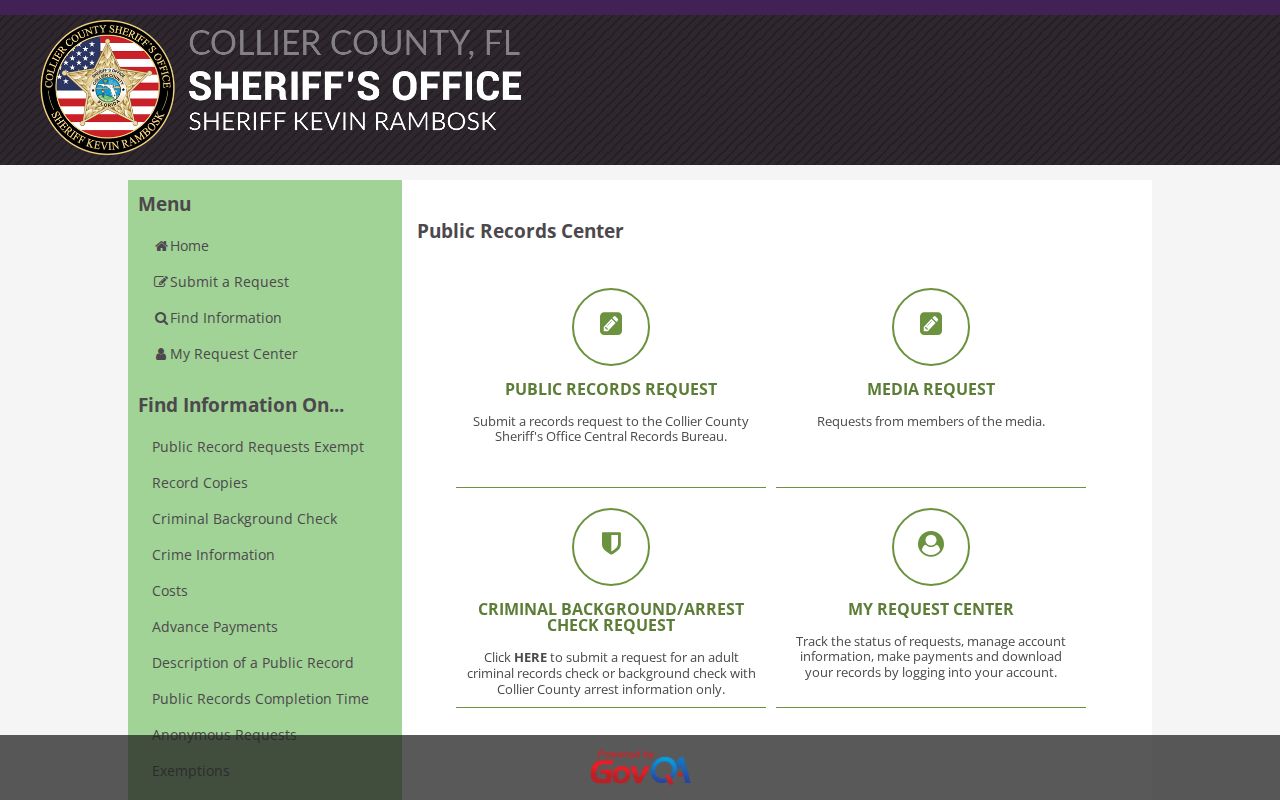
A narrow request tied to one booking episode is easier for the custodian to identify and less likely to return the wrong photograph.
FDC Photos for Collier County Releases
A person committed from Collier County to state prison may have a photograph in the FDC Offender Search. Search with the six-character DC number when possible, then compare the photo, committed name, birth date, aliases, sentence county, case number, and custody dates. A matching name alone is weak evidence.
The state image is an FDC offender photo, not necessarily the booking photo made at Naples Jail Center or Immokalee Jail Center. Different agencies and dates can yield different images. Its presence does not prove current imprisonment because FDC preserves records for released people and can show a past Release Date plus Date Out-Custody.
The official released-offender example shows how the photo sits with release and incarceration history.
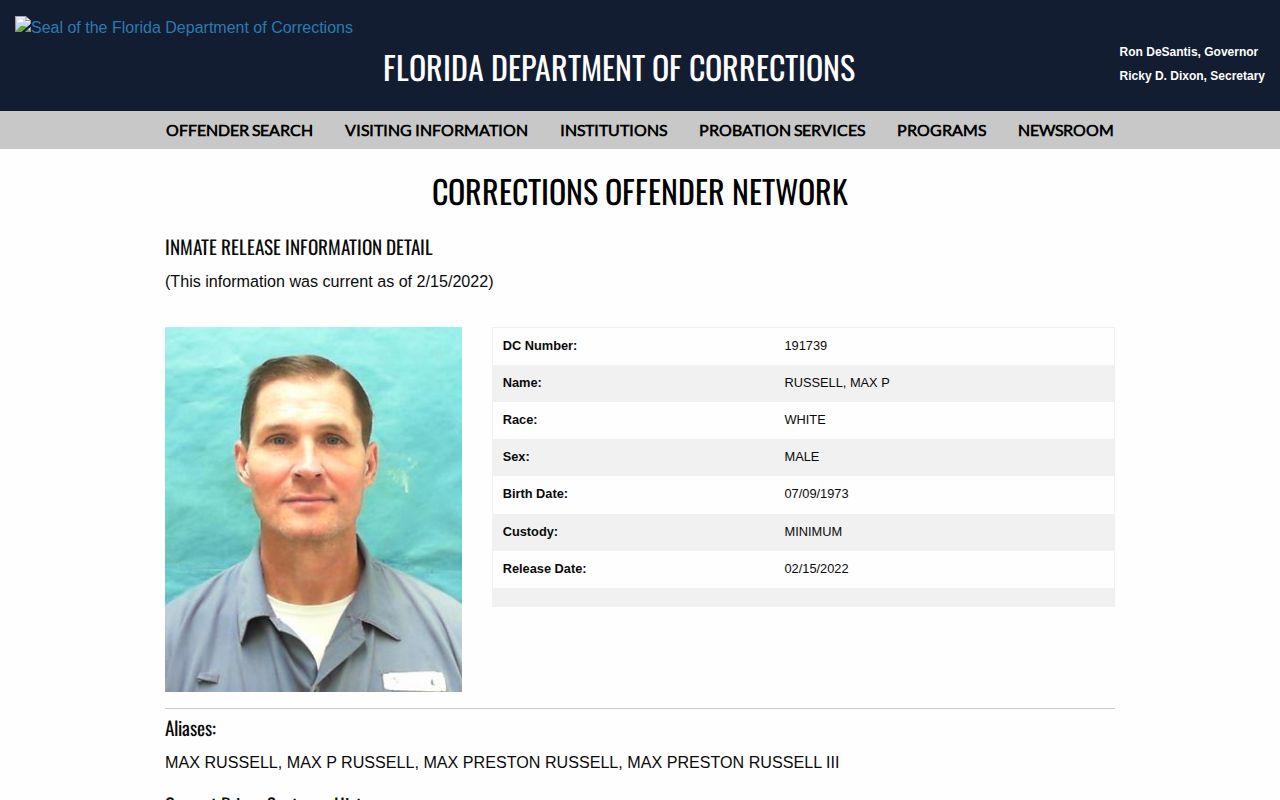
Read the image with the dated state record and label its agency correctly. Do not call it a Collier jail release mugshot.
Collier County Mugshots in News
CCSO Media Relations and established local news may publish an arrest photo with incident coverage. The article date, allegation, and image can help locate the correct arrest, but they do not prove release, dismissal, conviction, or present custody. Return to CCSO for the booking and release record and to the Clerk for the case outcome.
Commercial aggregators may also preserve copied photos after release. Their entries can be stale, incomplete, misidentified, or detached from later disposition. No commercial mugshot site is linked or endorsed here. If a copied entry conflicts with the official record, the CCSO, Clerk, or FDC source controls the factual verification.
Absence from news or a commercial index means little. Coverage choices and search-engine removal are not custody events. Likewise, continued publication does not mean the person is still in jail.
Note: News and copied images are discovery leads only; confirm identity, release, and case outcome through the responsible government offices.
Collier County Mugshot Removal Rules
CCSO's arrest-photo policy is explicit. Mugshots and arrest information remain public regardless of case outcome and are removed from the sheriff's site only because of a chapter 119 exemption, court order, or expunction. A dismissal by itself does not establish that one of those events occurred.
Florida sealing and expunction are formal legal processes. Eligibility is fact-specific and may require FDLE certification and a court order under sections 943.0585, 943.059, and related law. Verify that the order exists and deliver the qualifying material to the official custodian. Do not assume the arrest vanished because time passed or the charge ended.
Florida Statute 901.43 separately regulates a limited class of commercial booking-photo publishers. A person or legal representative may send the covered publisher's registered agent a written demand by registered mail with proof of identity and enough information to identify the photo. The current statute requires covered removal without charge within ten calendar days and bars republication.
That commercial rule is not a universal erasure demand against CCSO or ordinary news coverage. It also does not replace correction of a wrong source record. The practical order is to correct factual errors with the source agency, use a qualifying exemption or court/expunction order with CCSO, and use section 901.43 only when its covered-publisher definition applies.
Verify a Collier County Photo
A reliable match links the image to one arrest number, booking date, and agency. Then it separates three later facts: when custody ended, where the person went, and how the court case ended. Those facts may appear in different records. CCSO supplies the booking and local release event, the Clerk supplies the judicial disposition, and FDC supplies any state-prison continuation.
If the person moved from a Collier jail to FDC, ICE, another county, or federal custody, the county event was a transfer rather than community release. A photo cannot reveal that destination. Ask Jail Records at 239-252-9506 for the actual release type and receiving agency, then follow the next system.
For an older web image, note the source and capture date. Compare the official identifiers again before describing it. The strongest conclusion is narrow: this is the booking or offender photograph tied to the matched record. Release and disposition still require their own proof.
Search Collier Release Photos
Sponsored Results