
Collier Juvenile Release Paths
The Collier Juvenile Detention Center is a Florida Department of Juvenile Justice facility for youth awaiting adjudication, disposition, or commitment placement. Adjudication is the juvenile court's finding on the case. Disposition is the court's order about what follows. Commitment is placement in a DJJ residential program. These terms describe a system that is distinct from adult booking, sentencing, and prison discharge.
A youth may leave secure detention with an authorized adult under court conditions. Another youth may move to home detention or juvenile probation. A third may transfer to a residential commitment program. Only the first paths may involve a return home, and even then court conditions can remain active. A transfer ends the stay at this building but does not end DJJ custody or the juvenile case.
| Juvenile event | Correct confirmation source |
|---|---|
| Release to authorized adult | DJJ, counsel, and juvenile court order |
| Home detention or probation | Assigned juvenile officer and court |
| Commitment placement | DJJ placement contact |
| Adult-system event | Use adult system only if officially directed |
Confirm Collier Youth Release
Authorized parents, guardians, attorneys, and other approved contacts should begin with the official facility. Provide the youth's full legal name, birth date, case information if known, and the caller's relationship to the youth. Staff may need to verify identity and authority before discussing any detail. That safeguard is expected. It does not mean that a release or placement record does not exist.
- Call Collier Juvenile Detention Center at 239-397-6000 and identify the specific youth and the caller's authority.
- Ask whether the current event is release to an authorized adult, home detention, juvenile probation, or transfer to a commitment placement.
- Confirm instructions, approved recipient, court conditions, reporting directions, and pickup details directly with DJJ.
- Use the youth's lawyer or juvenile court for the controlling order and any question DJJ cannot disclose by phone.
Do not use an arrest photograph, social post, or adult custody result as a substitute. Juvenile records can be withheld or limited by law. A person who lacks legal authority may receive no case-specific answer. The proper response is to use counsel and the court, not to search for copied information elsewhere.
Note: A departure time should not be announced until DJJ confirms both authorization and the receiving person or placement.
Collier Juvenile Center Contact
DJJ lists the facility at 3351 East Tamiami Trail, Naples, Florida 34112, with telephone number 239-397-6000. This is the direct official route for facility questions. The adult Naples Jail Center sits nearby in the county system, but proximity does not merge their records, rules, staff, or release process.
Collier Juvenile Detention Center3351 E. Tamiami Trail
Naples, FL 34112
239-397-6000
Florida Department of Juvenile Justice
Before travel, confirm that the caller is an approved recipient and that release processing is complete. Ask what identification is required, who may pick up the youth, and whether the court has imposed a specific destination or reporting step. The research does not publish a general lobby or release-counter schedule, so none should be assumed.
Questions about the merits of the case belong with counsel and the juvenile court. Facility staff can address operational instructions within their authority. They should not be asked to provide legal advice or to disclose protected facts to someone who cannot establish a right to receive them.
Collier Youth Detention Facts
The official DJJ description identifies a 40-bed, hardware-secure detention center. Hardware-secure means the building uses secure physical controls for detention. It reports an approximate average secure-detention stay of 13 days. That average describes a group over time. It is not a countdown, a promised release date, or a sound estimate for one youth.
Individual timing depends on the juvenile court, legal status, detention review, placement availability, and DJJ instructions. A youth may leave sooner or remain longer than the published average. No arithmetic based on the average can replace the current court order and a direct answer from authorized officials.
The official DJJ facility page shows the distinct juvenile setting and contact route.
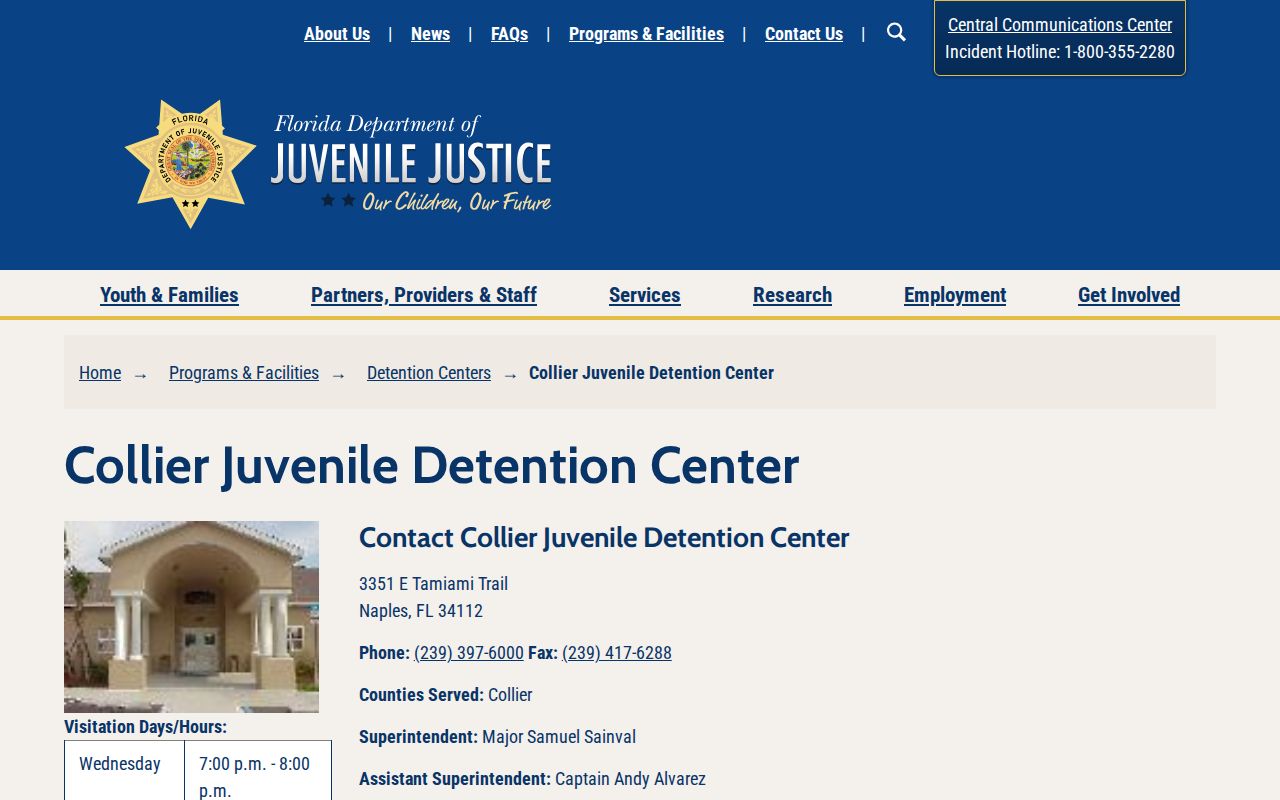
The state page supports the key boundary: this is a DJJ youth facility, not an adult jail search result.
Protected Collier Youth Records
Florida's broad public-record framework includes exemptions and confidential categories. Juvenile information is one of the areas where access can be restricted. Medical information, victim information, safety-sensitive material, sealed records, and other protected facts may also be withheld or redacted. An agency can release a permitted portion while protecting the rest.
That means an adult-style request for a public release list is the wrong expectation. An authorized person may ask for records through the channels DJJ or the juvenile court provides, but access depends on identity, role, and governing law. A general public requester should not expect the same fields available in an adult county jail log.
- Adjudication
- The juvenile court's determination in the case.
- Disposition
- The juvenile order that sets the next legal step.
- Home detention
- Court-directed restriction outside secure detention, not an unrestricted discharge.
- Commitment
- DJJ placement following the juvenile court process.
Absence from a public search proves little. It can reflect confidentiality, spelling, a different system, or a protected record. The official DJJ and court route provides the lawful answer.
Collier Release Versus Transfer
A secure-facility exit must be described with precision. Release to an approved adult can end detention at the center while juvenile probation or court conditions continue. Home detention occurs outside the secure building but remains a court-controlled status. Transfer to a residential commitment program is continued juvenile custody at a different placement.
Ask three separate questions: Did the youth leave this building? Who received the youth? What court or DJJ status began next? Those answers avoid the common error of calling every departure a discharge. A discharge generally means the end of the particular legal custody or supervision stated in the governing record. It should not be inferred from a building change.
Adult FDC Community Corrections is also not juvenile probation. County adult Pretrial Supervision is not home detention in a juvenile case. Similar words can conceal different agencies and legal authority. Preserve the terms used by DJJ and the juvenile court.
After Collier Youth Release
Before pickup, obtain the exact instructions from DJJ. Confirm the approved adult, identification, destination, medication or property process, and first reporting requirement. If probation or home detention begins, identify the assigned officer and the controlling court conditions. Do not borrow an instruction from another youth's case.
When commitment follows, ask DJJ for the placement contact and the permitted family communication route. A transfer can take time to appear in a system available to authorized participants. Facility staff, counsel, and the court can explain which office holds the current record.
The general Collier County release-record overview explains adult county, state, federal, and immigration paths, but its adult search sequence does not apply here. The juvenile center stays segregated because the population, legal process, confidentiality rules, and lawful recipients differ.
Keep a record of the official name, call time, instructions, and any case number provided. If sources conflict, return to counsel or the issuing court order. The order and current DJJ confirmation control over assumptions drawn from a public adult database.
Resolve Collier Youth Record Conflicts
Conflicting dates must be taken back to the authorized juvenile source. A detention-center exit, a court order, home detention, probation, and commitment placement can mark different steps. Ask counsel or the juvenile court which order controls, then ask DJJ to confirm the custody or placement event that followed. An adult CCSO arrest entry, FDC search, or public aggregator cannot resolve that protected youth sequence.
Write down the case reference, the office contacted, and the exact instruction given. Authorized adults should request only records they are permitted to receive and should expect confidential material to remain restricted. If DJJ directs the inquiry to another program after transfer, use that program contact without describing the move as community release unless the official record supports it.