
Collier County Parole and Probation
Leaving custody does not always end a sentence. Florida felony probation, community control, conditional release, and parole can all place a person in Collier County while legal duties continue. The Florida Department of Corrections, or FDC, handles field supervision for state felony cases. The Florida Commission on Offender Review, or FCOR, makes or reviews parole and certain commission-controlled release decisions. The Collier County jail roster is not the right source for either agency's current supervision status.
Probation is imposed by a court, often as the sentence or as a term that follows confinement. Parole is discretionary release before a sentence expires under FCOR conditions, but Florida abolished ordinary parole eligibility for most crimes committed on or after October 1, 1983. Conditional release is another state-created form of post-prison supervision and should not be relabeled as parole. County Pretrial Supervision is different again. It follows a judge's release order while a criminal case is still open, rather than a post-conviction FDC sentence.
| Status | Who creates it | Best verification source |
|---|---|---|
| Felony probation | Sentencing court | FDC Supervised Population record and Collier Clerk docket |
| Community control | Sentencing court | FDC record, assigned office, and court order |
| Legacy parole | FCOR | FCOR final action plus FDC supervision record |
| Conditional release | Florida law and FCOR action | Exact FCOR/FDC status and supervision history |
| Pretrial supervision | Collier County court | Clerk docket and CCSO Pretrial Release |
A single word can change the result. Report the exact official label instead of treating all community supervision as parole.
- Parole
- Discretionary release before a sentence ends, subject to commission terms.
- Probation
- A court-ordered community sentence supervised under stated conditions.
- Community control
- A more restrictive form of community supervision administered by FDC.
- Absconder
- A person alleged by the supervising authority to have stopped reporting or left supervision without approval.
- Discharge
- The documented end of the supervision obligation shown in that record.
Verify Collier County Post-Release Supervision
The official starting point is the FDC Supervised Population Search. A six-character DC number is safer than a name because it is FDC's primary identifier. Name searches can return several people or prefix matches. Compare the photograph, birth date, aliases, case numbers, sentence county, supervision type, and dates before deciding that a record belongs to the Collier County person in question.
- Search by DC number when available. Otherwise enter the full name and narrow the match with identity details.
- Open the detail record. Read the supervision begin date, current status and location, supervision type, scheduled termination date, and case history.
- Check the sentence county and case number against the Collier Clerk court-record search. The court order shows what the judge imposed.
- Use the location or office field to identify the assigned FDC unit. Do not assume every Collier County record reports to Naples South.
- When a recent change matters, confirm it with FDC Probation and Parole Field Services at 850-717-3444 or co-supervision@fdc.myflorida.com.
- If the term is parole or conditional release, obtain the actual FCOR action before stating the outcome.
FDC says the supervised-population dataset is fully refreshed weekly, while termination dates and locations update nightly. That cadence means a newly entered order, discharge, move, or violation may not appear everywhere at once. A scheduled termination date is also not proof that supervision ended. Look for the completed status or confirm with the assigned office.
Note: A person can be outside a Collier County jail and still be under strict state or local court supervision.
Collier County Probation Field Office
Collier County is part of FDC Community Corrections Circuit 20. The official circuit directory lists Unit 201, Naples South, as a local field office. An offender record should still be checked before any visit because the assigned office may differ, and FDC can change reporting instructions or locations. The office does not replace the public search for identity matching.
FDC Community Corrections Unit 201
Naples South
2500 Airport Road South, Suite 114
Naples, FL 34112-2884
Phone: 239-417-6300
View the FDC Circuit 20 directory and verify the assigned office before visiting.
County Pretrial Supervision is not handled through this field office. CCSO lists Pretrial Release at 239-252-9650. For that local status, start with the Collier Clerk docket and the judge's current order, then contact the local program if the public record does not resolve the question.
Collier County Supervision Terms and Violations
Conditions come from the court order, FCOR action, and FDC instructions that apply to the individual case. They can include reporting duties, location limits, treatment, payment, or other lawful terms. A public record may identify the supervision type and dates without displaying every current instruction. The underlying order and supervising office are more reliable than assumptions drawn from another person's case.
A violation entry, absconder notation, or warrant can start a retaking process, but it does not itself prove that the person is now confined. Records may show an allegation while a court or commission proceeding remains pending. Match the DC number or case number, check the date, and seek current confirmation. An old status copied elsewhere can remain visible after the matter changes.
For FCOR-controlled release, a violation can lead to revocation and return to prison. For court probation, the docket may show an affidavit, warrant, hearing, modified terms, or revocation order. The record should be reported as a sequence, not collapsed into a claim that release never occurred.
When Collier County Supervision Ends
Supervision ends through the authority that controls it. A court may terminate probation or community control, FDC may update the supervision record after the lawful end date, and FCOR may issue a final action for a commission-controlled status. The scheduled termination date is useful, but the completed discharge or termination entry is stronger evidence. New orders, violations, or corrections can change the expected end.
The Collier Clerk docket can preserve an order terminating probation or resolving a violation. FDC history can show a past supervision period and its status. If the two sources appear to conflict, note each label and date, then ask the custodian to reconcile them. The broader Collier County released-inmate search and records path explains how a jail exit, court action, and later state record fit together.
Discharge from FDC or FCOR supervision does not erase the earlier arrest, sentence, or release record. Sealing or expunction is a separate legal process with its own eligibility and court requirements.
Note: A future termination date is a projection; use a completed FDC status or court order to confirm the term actually ended.
Collier County Warrants After Release
A completed release from Naples Jail Center or Immokalee Jail Center does not clear an unrelated warrant or a later supervision violation. CCSO operates a public warrant search and its Fugitive Warrants Bureau handles current warrant questions. A name-only match is not enough. Compare the issuing court, case number, date, and identifiers, then obtain current confirmation before describing the warrant as active.
The CCSO warrants page lists the bureau at 239-252-9655 on Monday through Friday from 8 a.m. to 5 p.m. It directs after-hours callers to 239-252-9300. An FDC absconder result and a CCSO warrant result are also not interchangeable. One comes from the supervision system; the other reflects an outstanding local warrant record.
If a violation led to custody, the jail or FDC record should show the new custody leg. If no current custody record appears, do not infer that the person remains free or has been arrested. The issuing source must answer that question.
Collier County Reentry After Release
CCSO maintains a release-specific Reintegration resource with English and Spanish guides, a veterans guide, and routes for health care, recovery, food, clothing, transportation, benefits, and other basic needs. It is a local support channel, not a supervision lookup and not proof of discharge.
Purpose-neutral help is available through reentry@colliersheriff.org and the published reintegration numbers 239-252-9574, 239-252-9575, 239-252-9550, and 239-252-9530. A person can use those services while under FDC supervision, county pretrial conditions, or no supervision at all. The legal status still comes from the court, FDC, or FCOR record.
This distinction matters in Collier County. Support after release and official supervision are two separate systems. Assistance from a reintegration contact does not create, change, or end probation or parole.
Collier County Registry Status After Release
The FDLE offender registry uses the precise status Released – Subject to Registration for a covered person who is no longer confined or supervised but remains subject to registration law. That status is not the same as active probation or parole. It is also not a general released-inmate search because the registry covers only the population defined by statute.
FDLE separately identifies FDC, DJJ, and federal supervision in the registry context. Compare the photo and identifiers before using a record, and rely on the exact status shown. No registry result is expected for most released people and proves nothing about their custody or supervision history.
The narrow registry label can answer a specific question that a jail roster cannot: the person may be fully released from both custody and supervision while a registration duty continues. Treat that as a distinct legal status.
Note: Registry coverage is offense-specific and must never be used as a general list of Collier County released inmates.
Collier County Parole Decision Records
FCOR publishes a continuing Commission voting schedule. Agenda entries can show a name, DC number, county, offense, case number, and the category of a scheduled matter. A Collier County value links the matter to a court or sentence; it does not show where the person is physically held.
The schedule and agenda prove only that a matter was placed before the Commission. They do not establish a grant, denial, deferral, effective release date, or revocation. No separate public searchable results database was verified. For an outcome, request the final FCOR action, order, vote sheet, or release-date decision from the Commission's records office.
The official agenda example demonstrates the level of detail a scheduled matter can carry.
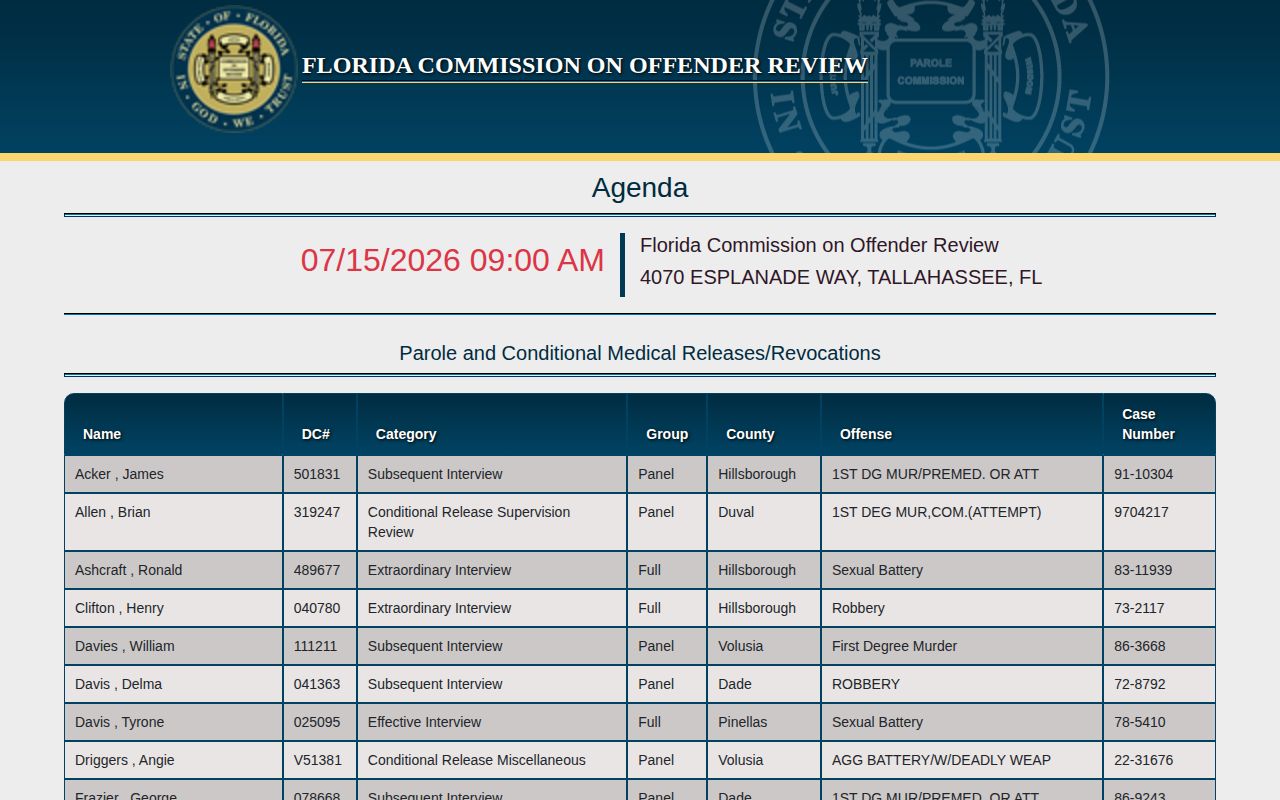
Read it as a calendar entry, then obtain the final action before stating that parole or another release status was approved.
Search Collier Supervision Records
Sponsored Results