
Collier County Projected vs Actual Release
A projected date is the agency's current computation of when a custody term may end. FDC's live public label is commonly Current Release Date. Florida law calls the statutory computation a tentative release date. Neither phrase is a promise that physical release will occur on that day. Gain time, sentence changes, detainers, and data corrections can alter it.
An actual release is a completed event. For FDC, the historical record may show a past Release Date and incarceration-history fields labeled Date In-Custody and Date Out-Custody. For Naples Jail Center or Immokalee Jail Center, the CCSO release screen or log can record the actual date, time, release type, and destination. A court order authorizes release but may not show when jail staff finished the handoff.
A person awaiting trial often has no set release date. Bond may be posted, a judge may order pretrial supervision, charges may change, or another agency may lodge a hold. A sentenced prisoner has a term from which an official computation can begin, but even that result remains subject to lawful updates.
Find a Collier County Projected Release
Start by classifying the custody. FDC is correct only for a state prisoner or a person in FDC Community Corrections. It does not calculate a short Collier County jail stay that never became a state case. The Collier County released-inmate search provides the broader jurisdiction path when custody is unclear.
- Locate the arrest or case number and decide whether the person is in a Collier jail, FDC prison, federal custody, immigration custody, or community supervision.
- For FDC, open the Corrections Offender Network menu and search by the six-character DC number when possible.
- Match the photograph, birth date, aliases, sentence county, case number, and incarceration dates. A name prefix can produce unrelated people.
- Read the exact Current Release Date warning, current location, sentence cases, and any supervision information. Preserve the retrieval date because the field can change.
- For a Collier County sentence, read the judgment and jail-credit notation in the Collier Clerk docket, then call Jail Records at 239-252-9506 for the recorded date.
- For a detailed state computation, request the release certificate and sentence-computation or release-date audit through the FDC Public Records Center.
FDC's release database includes both people already released and people scheduled for release, and the agency says the data is updated nightly. A past date in the release dataset should be read with Date Out-Custody and the next status. A current record may instead show TO BE SET or SENTENCED TO LIFE. Do not turn either label into a guessed date.
Note: Use the DC number whenever possible; FDC name searches are prefix-based and may return several people with similar names.
Collier County FDC Release Fields
The state result is a timeline, not one isolated number. Identity and sentence fields show whether the record matches the Collier County case. Custody and release fields distinguish a current projection from a finished prison term. Community-supervision data can show that prison ended while legal control continued outside the institution.
| FDC field | What it establishes | Reading caution |
|---|---|---|
| DC number | Primary state offender identifier | Use it to avoid name confusion |
| Current Release Date | Displayed current projection for an imprisoned person | Subject to gain-time and record changes |
| Release Date | Past or scheduled date in the release dataset | Compare with custody history |
| Date In-Custody / Date Out-Custody | Start and end of a prison episode | A later custody episode may exist |
| Sentence county and case | Connection to the court judgment | Confirm that it is the Collier case |
| Supervision history | Post-prison legal status | Release from prison may not mean discharge |
The official FDC detail example shows how Current Release Date appears beside the agency's change warning.
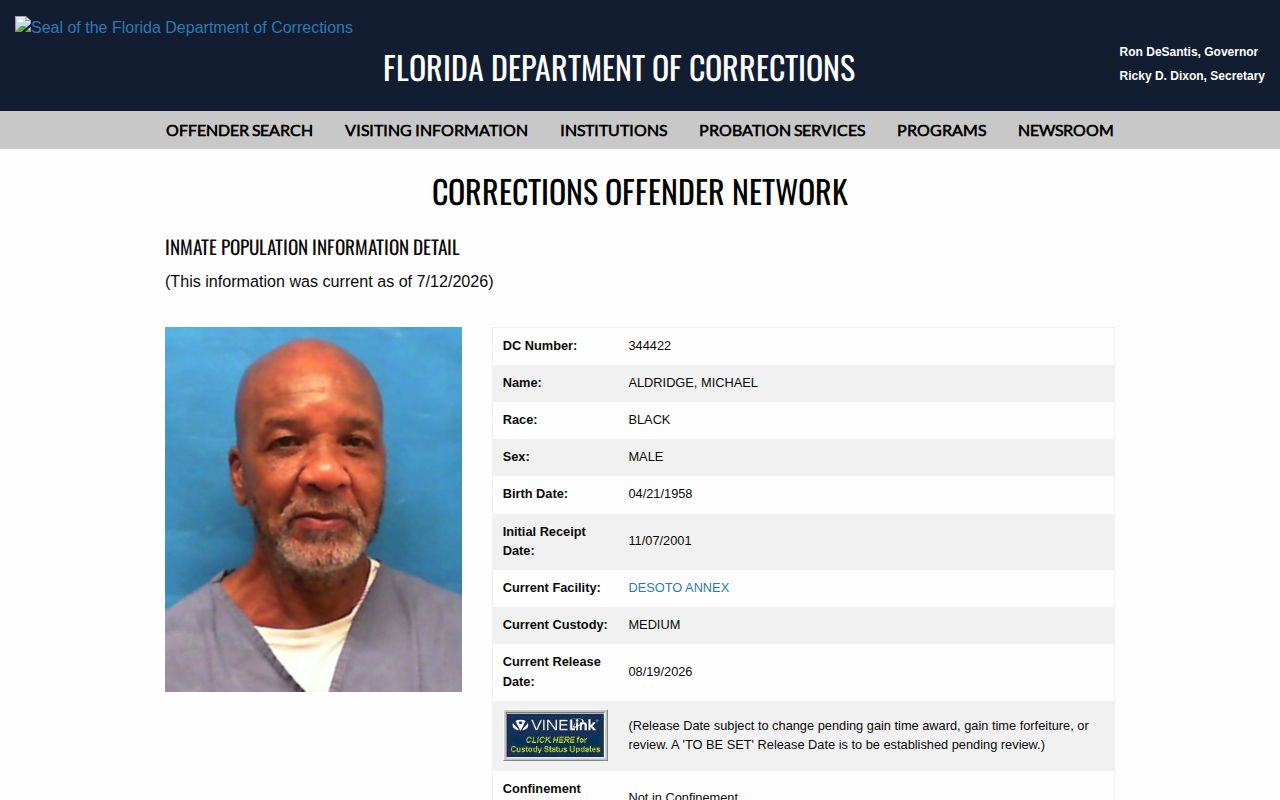
The warning is part of the record's meaning. A screenshot without it can make a dynamic date look final.
Florida Gain Time for Collier Releases
Section 944.275, Florida Statutes, is the core gain-time authority for FDC sentences. The calculation starts with the maximum sentence expiration date, meaning the imposed term or combined terms less lawful credit, including applicable jail credit. Gain time awarded or restored can move the tentative release date earlier. Forfeiture can move it later. The tentative date cannot extend beyond maximum expiration.
For offenses committed on or after October 1, 1995, the incentive-gain-time structure is constrained so the prisoner serves at least 85 percent of the sentence imposed. That is the source of Florida's familiar truth-in-sentencing shorthand. It does not mean every person automatically receives a 15 percent cut. Eligibility, awards, forfeitures, mandatory terms, sentence credit, and offense-specific rules still matter.
Offense date matters sharply. Section 944.275 has different basic and incentive gain-time provisions for older date groups, including pre-1994 offenses and the 1994 to 1995 period. It also addresses meritorious and certain educational awards. Older cases may fall under earlier sentencing and parole regimes. A simple sentence-length calculator cannot safely reproduce those rules.
Section 921.002 and the Criminal Punishment Code also inform covered sentences. Consecutive terms add in a different way than concurrent terms, while mandatory minimums can restrict an earlier exit. FDC's maintained computation and audit records control over a lay estimate.
Why Collier County Release Dates Change
A projected date moves when the legal or factual inputs move. The public field may update after the agency posts an award, loss, added sentence, corrected credit, court amendment, or detainer. Some factors change the computed date itself. Others prevent community release even when one custody term ends.
| Factor | Possible effect | Best record |
|---|---|---|
| Eligible gain time or restored credit | May move the tentative date earlier | FDC computation and gain-time history |
| Disciplinary forfeiture | May move the date later | FDC award and forfeiture record |
| New or consecutive sentence | Can require a new combined calculation | Court judgment and FDC audit |
| Amended sentence or corrected jail credit | Can move the date in either direction | Amended order and recomputation |
| Detainer or agency hold | May cause transfer instead of community release | Release destination and receiving-agency record |
| FCOR action | May establish, defer, or revoke a commission-controlled date | Final FCOR action, not an agenda |
A county release to FDC, ICE, the U.S. Marshals Service, another county, or another secure agency is a transfer. It is not proof that the person went home. The Collier release log should identify the type or destination when recorded, and the receiving system continues the timeline.
Collier County Jail Release Computation
The CCSO jail-information page does not publish a verified county good-time-per-month formula. It also does not confirm a weekend or holiday early-release policy. A Collier County jail sentence must therefore be read from the judgment, jail-credit finding, and CCSO's actual release record. Importing FDC's prison gain-time formula into a Naples or Immokalee jail sentence would create an unsupported date.
Ask Jail Records how the maintained date was applied to the specific booking number. The useful record set includes the judgment and sentence, any amended order, credited days, the release screen, release type, actual timestamp, and destination. If the case changed, the Clerk docket can show the later order. If the person was committed to state prison, switch to FDC after the county handoff.
Pretrial detention is even less suited to calculation. Cash bond, a cashier's check, a surety bond, or court-ordered pretrial supervision may end local custody, but staff processing and other holds still matter. The scheduled court date is not the release date.
Naples Jail Center and Immokalee Jail Center operate within one CCSO jail system. A move between those buildings is an internal transfer, even if a person disappears from one facility view. Placement is based on classification rather than proximity to home. Ask whether the maintained event was a building transfer, release to the community, or delivery to another agency. That destination can matter more than the date alone.
Bond also answers only part of the timing question. CCSO accepts cash for the full amount, a cashier's check for the full amount, or a surety bond through a bonding company. A judge can instead order a qualified person onto Pretrial Supervision as a bond condition or without monetary bail. Either path may authorize departure, but neither establishes the final case result. The Clerk docket remains the source for the court's conditions and later disposition.
Note: No verified Collier County jail good-time or weekend-release formula appears in the published research, so use the actual jail record.
Confirm a Collier County Release Date
For a pending event, a VINELink Inmate Search can provide a source-fed custody alert when the agency participates. It is notice, not a certified release record. A county alert may mark the end of CCSO custody even if FDC or ICE receives the person next. Confirm the event with the named custodian.
For a completed state-prison term, compare the past Release Date with Date Out-Custody, incarceration history, and supervision status. FDC lists its Bureau of Admission and Release at 850-488-9167 and dc.release@fdc.myflorida.com for release questions. A focused public-record request can seek the release certificate, institution of release, release type, computation audit, and relevant gain-time entries.
For Collier County custody, Jail Records at 239-252-9506 is the most direct operational source. A written request through the CCSO Public Records Center can ask for the booking sheet and release screen tied to the arrest number. State the exact date range and identifiers. The final answer should separate physical release time, legal authority, release type, and destination.
Once the person is already out, prefer the historical record over an old projection. That prevents a prior Current Release Date screenshot from being mistaken for proof of the actual exit.
Search Collier Release Dates
Sponsored Results