
Florida Prison Release Records
FDC is the custodian for people who entered Florida's state prison system and for felony Community Corrections records. A Collier County conviction can lead to placement far from Collier and later transfers between institutions. The county jail records the handoff to FDC, but the state record continues the prison timeline. That handoff is not release to the community.
After prison, a person may return to the community without supervision, begin conditional release, enter felony probation or community control, or remain subject to another authority. FDC's release and supervision datasets answer different questions. The historical release entry confirms the end of a prison episode. The supervised population entry can show that legal supervision continues outside prison.
| Question | FDC dataset |
|---|---|
| Already or scheduled for prison release | Inmate Release Information |
| Currently in a state institution | Inmate Population |
| Current felony supervision | Supervised Population |
| Stopped reporting | Absconder/Fugitive |
Search Florida Release Information
Open the Corrections Offender Network menu and select the dataset that fits the question. Use the six-character DC number whenever possible. FDC calls it the primary identifier. A name search is prefix-based, so a short entry can return many names. Compare birth date, photograph, aliases, physical description, sentence county, case number, and dates.
- Choose Inmate Release Information for a past or scheduled prison release.
- Enter the DC number, or search by name with enough detail to narrow the result.
- Open the matching record and verify Collier sentence and identity fields.
- Read Release Date with Date In-Custody and Date Out-Custody as a timeline.
- Check Supervised Population separately when post-prison supervision may continue.
FDC says the release database is updated nightly. A released detail may not carry a literal “Released” status. Membership in the release dataset, a past Release Date, and a matching Date Out-Custody together provide the public evidence. Preserve FDC's exact labels rather than converting parole, probation, conditional release, and supervision termination into one term.
Read Florida Release Fields
A public released record can show the photograph, DC number, committed name, race, sex, birth date, custody classification, Release Date, aliases, prison-sentence history, and incarceration history. The incarceration section's Date In-Custody and Date Out-Custody fields separate prison episodes. Sentence data links an episode to the court case, while supervision history can explain a community period that remains legally controlled.
- Release Date
- The public FDC date tied to the release record.
- Date Out-Custody
- The end date for the listed prison custody episode.
- Conditional release
- A statutory period of post-prison supervision for covered cases.
- Discharge
- The end of the custody or supervision identified in the record.
A photograph helps distinguish names but does not prove current imprisonment. It is an FDC offender image, not necessarily the Collier booking photo. A past prison release also does not rule out later county, federal, immigration, or new state custody.
Note: Record the retrieval date because public status and projected fields can change.
Florida Current Release Date
For a person still imprisoned, FDC may display Current Release Date. The agency warns that this date can change because of gain-time awards, gain-time forfeiture, or review. The field may instead say TO BE SET or SENTENCED TO LIFE. It is a current projection, not proof that a future exit will occur on that day.
Section 944.275 calls the statutory computation a tentative release date. The calculation begins with the sentence and lawful credit, then applies the rules for gain time, forfeiture, restoration, added sentences, and other adjustments. Offense date matters. For offenses on or after October 1, 1995, the statutory structure generally requires service of at least 85 percent, but that does not mean every prisoner receives a fixed 15 percent reduction.
Detainers, mandatory terms, consecutive sentences, court amendments, and corrected credit can also affect the practical date. An accomplished historical Release Date and Date Out-Custody are stronger evidence of an actual past exit than an old projection. For details, the Collier projected release page separates scheduled and actual dates.
Request Florida Discharge Records
When the public entry is incomplete, submit a focused request through the FDC Public Records Center. Identify the DC number. Ask for the release certificate or discharge document, incarceration and release history, institution of release, release type, supervision record, and the existing sentence-computation or release-date audit material relevant to the public field.
If a date changed, request existing gain-time award and forfeiture records instead of asking the custodian to give a legal opinion. FDC's portal explains that timing depends on scope and volume. Its research-period notice described a substantial backlog, so any estimate should be checked when the request is made.
Many electronic requests may have no charge. FDC can assess lawful duplication, postage, and special-service costs for extensive work, provide an estimate, and require payment before processing a charged request. Collier Central Records is not the custodian of state prison records merely because the sentence began in Collier County.
The FDC dataset menu visually separates current population, release, supervision, and other searches.
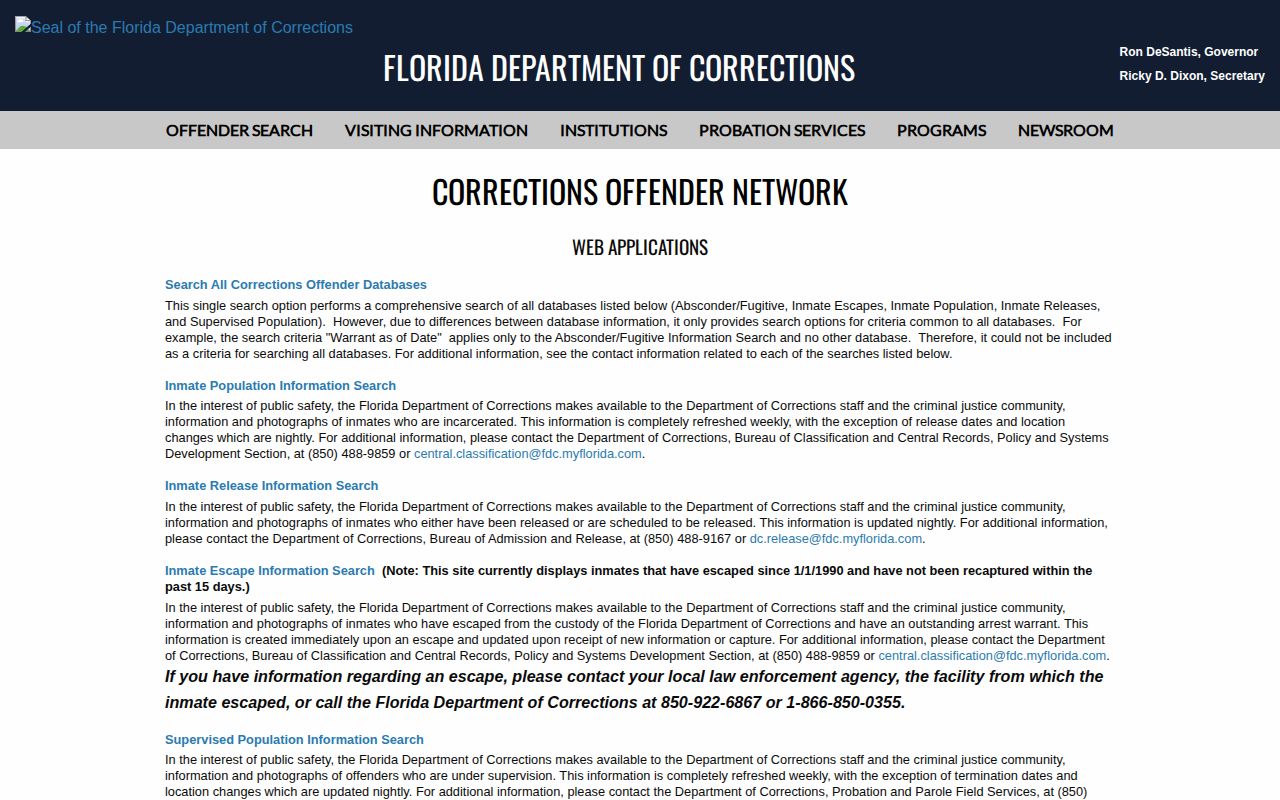
Choosing the correct dataset prevents a current-prison locator from being mistaken for a released-person archive.
Florida Release Contact Routes
FDC lists the Bureau of Admission and Release at 850-488-9167 and dc.release@fdc.myflorida.com for release questions. Probation and Parole Field Services is listed at 850-717-3444 and co-supervision@fdc.myflorida.com for supervision matters. Use the public portal for a record request and the operational contact for a timely status question.
Florida Department of CorrectionsCorrections Offender Network: statewide online search
Bureau of Admission and Release: 850-488-9167
Release email: dc.release@fdc.myflorida.com
Records: FDC Public Records Center
No single Collier County FDC prison address can represent the statewide system. Confirm the current institution from the matched record before using a facility contact. Prison assignments and transfers can change. A sentence county identifies the court connection, not current physical location.
Florida Release and Supervision
Release from a state prison can begin a separate supervision stage. Search the FDC Supervised Population dataset using the same DC number. A detail may show photograph, supervision begin date, current location or status, supervision type, scheduled termination date, aliases, and case history. FDC says the dataset receives a full weekly refresh, while termination dates and locations update nightly.
Florida felony probation is imposed by a court. Community control is a more restrictive form of community supervision. Conditional release is a statutory post-prison release type. Ordinary parole is largely a legacy program because Florida ended eligibility for most offenses committed on or after October 1, 1983. FCOR makes certain release decisions, while FDC Community Corrections handles field supervision.
An absconder record alleges that a person stopped reporting or otherwise failed to comply. It does not prove present custody. Compare the FDC record, issuing order, warrant source, and court docket. Never treat a name-only match as final.
Collier Prison Timeline
Build the timeline across agencies. The CCSO jail record shows departure from Naples or Immokalee and whether the destination was FDC. The Collier Clerk docket supplies judgment, sentence, jail credit, amendments, and later orders. FDC then shows prison admission, transfers, sentence history, projected field, completed release, and supervision when applicable.
County release to FDC is one custody transition. FDC release to supervision is another. Termination of supervision may be the later discharge. These events should not be collapsed into a single “release from Collier” date.
The Collier County release search covers county, court, VINE, federal, and immigration alternatives when the FDC record is not the right system. For a state-prison case, the DC number and exact FDC labels remain the strongest keys.
If a person later appears in ICE, BOP, or a county jail, preserve that later event separately. A past FDC release remains true for the completed prison episode, but it does not describe all later custody.
Verify Florida Release Data Updates
FDC states that the release database is updated nightly. A recent court change, transport, gain-time entry, or supervision action may therefore appear after the source event. Preserve the retrieval date, then recheck the matched DC number or contact the Bureau of Admission and Release when timing matters. A delayed public update does not allow a county roster or old screenshot to override the maintained state record.