
Collier County 72-Hour Release Reality
No official Collier County Sheriff’s Office rolling 72-hour release list was found. No separate 48-hour release product was verified either. The public CCSO system is an Arrest & Warrants Search with a calendar-day arrest report and older searches by name or booking date. Its own terms state that the information reflects arrest circumstances, not final disposition. That makes the system useful for locating the right booking episode, but not for deciding who left jail over three days.
The time axes are different. A person arrested within the last 72 hours may remain confined beyond the end of that window. A person who left during the same interval might have entered custody weeks earlier. Searching three adjacent booking dates therefore creates a list of bookings, not a release list. It also misses the core data needed for verification: the actual exit time, the release type, and any destination or receiving agency.
Check Collier Three-Day Releases
A reproducible three-day check starts with exact boundaries. Use Eastern Time and write both the starting and ending timestamp. A request such as Friday at noon through Monday at noon is different from three named calendar days. Clear boundaries help CCSO identify an existing database export and keep later comparisons consistent.
- Choose the precise 72-hour interval in Eastern Time. Record both dates and times, including the year.
- Submit a request through the CCSO Public Records Center for the releasable jail release log covering that interval.
- Ask for name, booking or arrest number, actual release timestamp, release type or code, and destination or receiving agency fields.
- Request any existing code key and ask that exempt fields be redacted rather than withholding the whole releasable record.
- For one urgent name, call Naples release information at 239-252-9504, Immokalee at 239-657-2878, or Jail Records at 239-252-9506.
Ask for an existing export in a routinely available format. Florida public-records law does not require an office to create a new analytical report if none exists. CCSO may clarify the scope, redact exempt information, or quote a lawful charge. Request a cost estimate before extensive work. The GovQA portal can track the request, accept any required payment, and deliver the responsive files.
For the tighter same-day method, compare the Collier County Jail Releases: 24 Hours process. That page focuses on one-day verification, while the three-day request is better for a multi-day gap.
Collier County 72-Hour Release Fields
Since no public CCSO three-day feed is verified, the following table describes fields to seek in the official release log. It does not describe a public screen. A useful record connects identity, custody episode, time, authority, and destination. Each element answers a separate question and helps prevent a booking record from being mistaken for proof of release.
| Field | What it establishes |
|---|---|
| Full name | Identifies the person as written in the Collier County jail record. |
| Booking or arrest number | Links the exit to one exact custody episode rather than another arrest. |
| Booking date | Helps match the release to the arrest search and court case. |
| Actual release date and time | Shows whether the physical handoff falls inside the 72-hour request window. |
| Release type or code | Distinguishes bond, pretrial supervision, court order, time served, sentence expiration, or transfer. |
| Destination or receiving agency | Separates return to the community from another secure custody leg. |
Transcribe the release code exactly. If it is not plain language, ask CCSO for the existing definition. A jail database may use “released” for the end of CCSO’s legal custody even when FDC, ICE, another county, a hospital, or another authorized custodian received the person. That event belongs in the three-day log, but it must not be described as a community return without destination evidence.
Note: The Collier Clerk docket may explain the release authority, but the jail log better fixes the physical exit time.
Collier County Weekend Release Checks
A 72-hour interval can bridge a weekend or holiday when a same-day check was missed. It can also capture separate release events from Naples and Immokalee within one county jail system. Still, the research found no published CCSO promise about weekend processing times, holiday release practices, or minute-by-minute web updates. Do not assume that a court order, bond posting, and physical exit share one timestamp.
Set the interval around the event being tested, not around the arrest date. If a court order was entered late Friday, for example, the relevant log request should extend far enough to capture the actual jail exit after processing. This is a method, not a claim about when a particular person left. A release may also be followed by transport. In that case, the CCSO timestamp marks the county handoff, while the receiving system holds the next status.
No result within the requested window should be handled carefully. Recheck spelling and the arrest number. Ask whether the person moved internally between the two CCSO centers, remained held, or left outside the chosen interval. If the office supplies a release code but not a clear destination, seek clarification from the record custodian instead of inferring that the person went home.
Collier County Release List Retention
Florida’s GS2 schedule, Item 22, expressly recognizes commitment and release lists for people booked and released during a 24-hour period. Listed fields can include the date, booking number, name, charge, bond, and how released. The minimum retention is one anniversary year after release. A 72-hour response can therefore be framed as three consecutive daily slices or one existing export across the full interval, depending on how CCSO stores the data.
This state schedule supports a records request, but it does not create a public CCSO web feed. Minimum retention also is not a promise that an agency destroys the record after one year or keeps it visible online for that span. CCSO may retain records longer, and exemptions still apply. Public display and agency retention are separate questions.
Central Records accepts requests online, at records@colliersheriff.org, by phone at 239-252-0637, by mail, or in person at 3319 Tamiami Trail East, Naples. Office hours are listed as Monday through Friday, 8:00 a.m. to 5:00 p.m., excluding recognized county holidays. CCSO asks for three to five business days for incident reports, but that is not a universal deadline for release-log exports.
Collier County Arrest Search Boundaries
The official arrest-search entry screen helps find a booking by date or name after the terms are accepted. It can supply the identifier needed for a targeted call or request. The CCSO terms and search screen shows that discovery path.
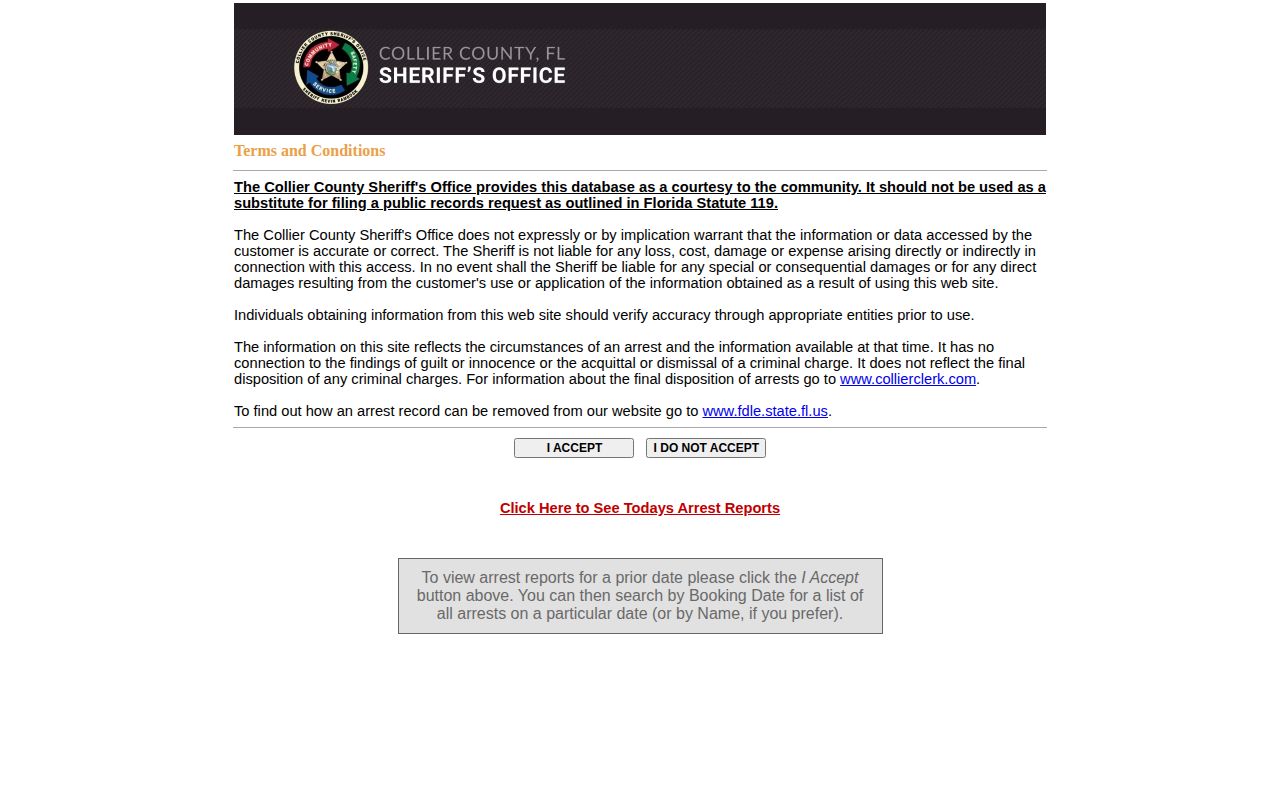
The screen should be read as an arrest-history tool. Its booking-date search cannot be converted into a 72-hour release report, and an arrest photograph does not prove present custody or release.
CCSO2go is another official arrest-history route. CCSO says the app’s enhanced arrest log can be searched by name or date and shows charges, a photograph, and ten years of Collier arrest history. The published app description does not confirm a release-status field, recent-release tab, or three-day release window. Use it to identify the custody episode, then move to Jail Records.
Note: A ten-year app arrest-history window is not a ten-year archive of online Collier County release events.
Verify Collier County Release Destinations
The release record determines the next source. A community release on bond, pretrial supervision, time served, court order, or sentence completion can be matched to the Collier Clerk docket. A transfer to Florida Department of Corrections belongs in the FDC Offender Search. FDC can preserve a state-prison release history, but it does not cover a short Collier jail stay that never entered the state correctional system.
VINELink is useful for notice about a specific person when the participating source supplies the custody event. It is not a historical release-list generator, and an alert is not a certified record. Federal Bureau of Prisons and ICE locators cover different systems. A person leaving CCSO for ICE or another agency has left county custody but may remain confined.
Naples and Immokalee must be treated as parts of one CCSO system. The sheriff’s materials explain that placement decisions turn on the safest suitable location rather than how close a jail is to the arrest or home address. A move between the centers can occur without release. When a three-day inquiry begins with only one facility name, ask Jail Records to check the complete custody episode and identify whether the event was an internal move, a community exit, or an outside-agency handoff.
| Collier record outcome | Next source |
|---|---|
| Community release | CCSO release log and Collier Clerk case docket |
| FDC commitment | FDC inmate, release, and supervision records |
| Immigration handoff | ICE locator after confirming the CCSO event |
| Still in CCSO custody or internal move | Naples, Immokalee, or Jail Records confirmation |
When the task is finding one named person across those paths rather than collecting a three-day interval, the Collier County released inmate search provides the jurisdiction-by-jurisdiction sequence. Juvenile detention is separate and should not be routed through these adult public-search methods.