
Understanding Collier County Releases
A release from the Collier County Sheriff's Office means one custody leg ended. It does not always mean the person went home. Naples Jail Center and Immokalee Jail Center operate as parts of the same county system, and CCSO may move a person between them for classification or care. A move between those buildings is not a release. An entry that sends someone to the Florida Department of Corrections, ICE, another county, or another secure agency is also a transfer, even though CCSO custody has ended.
For a true community release, the record may identify bond, pretrial supervision, recognizance, time served, sentence completion, or a court order. Each term answers a different question. The jail release record supplies the physical exit details. The Collier Clerk docket supplies the legal result. A later FDC or supervision record shows what followed. Keeping those sources separate prevents a release date from being mistaken for a final case outcome.
An official CCSO health-care solicitation gives dated scale for both adult centers. These FY2021 figures are historical operating counts, not current population totals or release rates.
Releases can exceed bookings within one fiscal-year slice because some people booked earlier leave during that year. The figures show turnover across the two-center system, not the likelihood that one person will be released.
- Time served
- A sentence satisfied by custody already completed.
- Pretrial supervision
- Court-ordered release conditions while the criminal case remains open.
- Discharge
- The end of the sentence or supervision obligation shown by that agency record.
- Detainer
- A request or legal basis for another authority to take custody.
Collier County Release Types
The label in the source record should be preserved. Similar outcomes can have different legal effects, and a local code should not be expanded by guess. These common paths show why the destination field is essential.
| Release path | Meaning | Next confirmation |
|---|---|---|
| Bond or recognizance | The person leaves jail while the case continues. | CCSO release record and Clerk docket |
| Pretrial supervision | A judge allows release under local conditions. | Court order and CCSO Pretrial Release |
| Time served or sentence end | The county custody term is complete. | Judgment, jail credit, and actual exit record |
| FDC commitment | County custody ends and state prison custody begins. | FDC Offender Search |
| ICE or other agency | Another custodian receives the person. | Destination agency locator or record |
Death can also close a custody episode, and protected records may limit what appears publicly. When the code is unclear, ask Jail Records for the code definition or data dictionary attached to the existing record.
How Collier Bond Release Works
CCSO's jail information identifies three bond methods: cash for the full amount, a cashier's check for the full amount, or a surety bond through a bonding company. A judge may instead place a qualified person on Pretrial Supervision as a bond condition or without monetary bail. The conditions are set at first appearance and the case remains unresolved.
A bond entry proves neither dismissal nor sentence discharge. Match the release to the booking number, then read the Clerk docket for later hearings, disposition, or changes to conditions. The physical release time may follow the judge's order because staff must process the order and check for other holds. A completed exit should therefore be confirmed in the jail record, not inferred from the time an order appeared on the docket.
Collier County Release Record Fields
A useful Collier County release record ties one person to one booking episode. Full name alone is weak because a person may have several arrests or share a name. Ask for the booking sheet and release screen or log together so the identity, authority, time, and destination can be read as one chain.
| Field | What it establishes |
|---|---|
| Name and date of birth | The person identified in the custody episode |
| Arrest or booking number | The exact Collier booking tied to the release |
| Booking date | The start point for that jail episode |
| Actual release timestamp | When physical processing ended |
| Release type or code | The recorded authority or manner of release |
| Order or bond reference | The source authorizing the exit when recorded |
| Destination or receiving agency | Whether the person entered the community or another custody system |
The public arrest search is not a substitute. CCSO states that its arrest data reflects the circumstances at arrest, not the final disposition. A photo or arrest history may remain after release, while the release timestamp may require a direct inquiry.
Request Collier County Release Records
CCSO Central Records accepts requests online, by telephone, email, mail, and in person. A narrow request costs less to locate and reduces the risk of receiving the wrong person's file. Chapter 119 does not require an ordinary requester to explain a purpose.
- Collect the full name, date of birth if known, booking or arrest number, and approximate booking date.
- Open the CCSO Public Records Center, or send the same focused wording through another Central Records channel.
- Ask for the releasable booking sheet, release screen or log, actual timestamp, release code and definition, authority, destination, and booking photo if needed.
- Request electronic copies and ask for notice before costs exceed a stated limit. Exempt fields may be redacted.
- Compare the response with the Clerk docket or receiving-agency record when the destination shows a transfer.
The official CCSO request portal shown below lets a requester submit, track, pay for, and download a response.
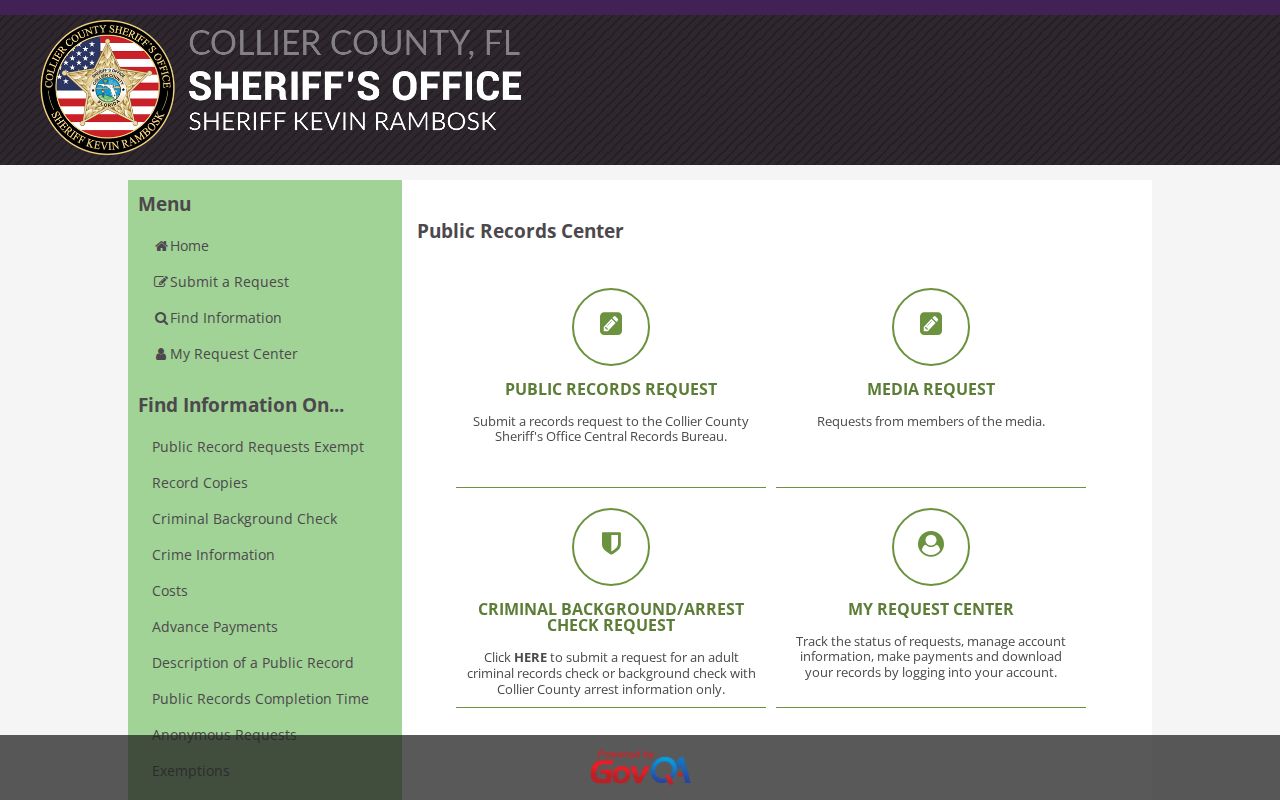
The portal is the written-record route when a phone confirmation is not enough. Central Records is at 3319 Tamiami Trail East, Naples, and publishes weekday office hours. Its stated three-to-five-business-day allowance concerns incident reports, not a guaranteed deadline for every release-log request.
Collier Release Record Retention
Florida Constitution article I, section 24 and chapter 119 support access to nonexempt state and local records. Section 119.07 governs inspection, copies, lawful copy charges, and a special service charge when a request requires extensive technology or staff work. The Florida GS2 schedule adds a useful minimum: Item 16 booking records and Item 22 commitment and release lists are kept for at least one anniversary year after release. An agency may keep them longer.
Web visibility is different from retention. CCSO2go describes ten years of Collier arrest history and photographs, but that is an app display statement, not a ten-year release-feed promise. Juvenile, sealed, expunged, victim-protected, medical, and security-sensitive information may be confidential or redacted. CCSO says an online arrest photo is removed only for a chapter 119 exemption, court order, or expunction, regardless of case outcome. A dismissal alone should never be described as automatic expunction.
Can an old release record still be requested? Possibly. Ask the custodian for the existing record even when it is no longer visible online, and let the agency apply retention and exemption rules.
Find Collier County Released Inmates
Start with the jurisdiction that held the person. There is no universal released-inmate database. A Collier jail episode, an FDC prison term, a federal sentence, and an immigration handoff leave different records.
- Search the official CCSO arrest history by exact name or likely booking date and record the arrest number. Treat the match as an episode locator only.
- Call Naples, Immokalee, or Jail Records and ask for the actual release date, type, and destination. Cover both jail centers.
- Read the Collier Clerk docket in date order for bond orders, disposition, judgment, jail credit, probation, or later warrants.
- If the destination is FDC, search by DC number and examine release, incarceration, sentence, and supervision history.
- Use VINELink for custody-event alerts, BOP for federal custody, and ICE for an immigration transfer. Confirm the event with the source agency.
- Submit a focused records request when an online view is missing, ambiguous, archived, or not detailed enough.
Florida Search for Collier Releases
The Florida Department of Corrections is the right source only when a person entered FDC prison custody or Community Corrections. The Corrections Offender Network separates Inmate Release Information, current inmate, supervised population, and absconder datasets. A six-character DC number is the safest key. Name searches are prefix-based, so every match needs comparison against birth date, photo, aliases, sentence county, case numbers, and custody dates.
| FDC field | How to read it |
|---|---|
| DC number | Primary state correctional identifier |
| Release Date | Past or scheduled date within the release dataset |
| Date In-Custody / Date Out-Custody | Historical prison episode boundaries |
| Current location or status | Present prison or supervision position |
| Current Release Date | Changeable date displayed for a person still imprisoned |
The official FDC dataset menu illustrates why the correct search type matters.
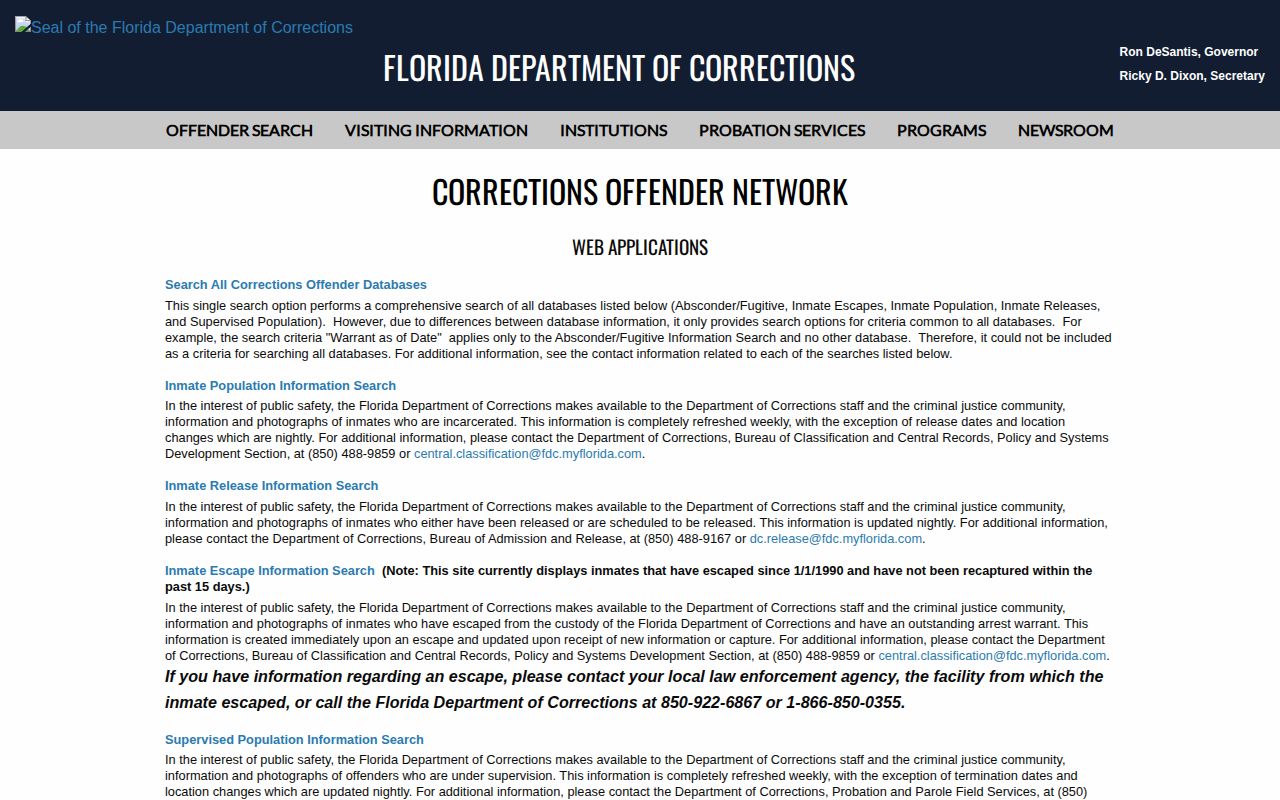
A past Release Date plus matching Date Out-Custody is stronger than a projection, but the next status may still be supervision or another custody leg. County-only jail stays will not appear here.
An official public released-offender example shows how a photo, Release Date, sentence history, and custody dates appear together.
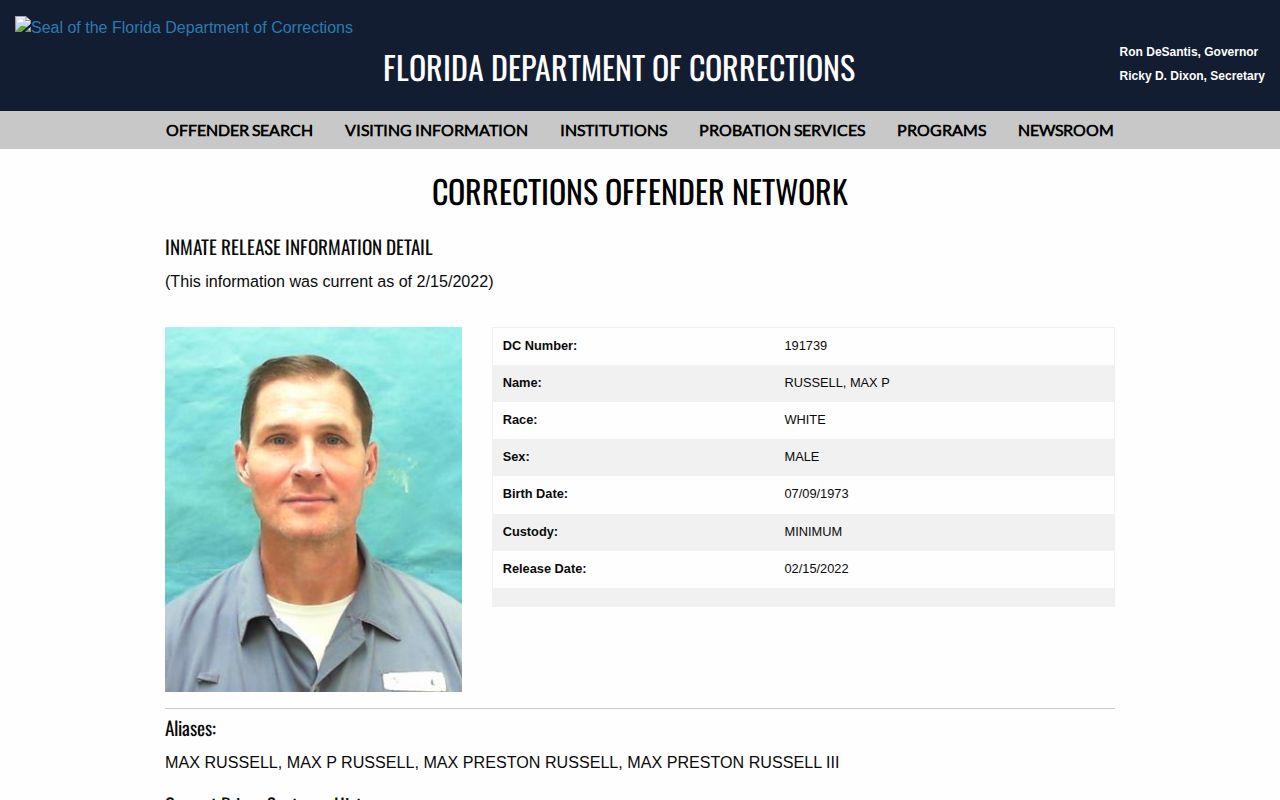
The example demonstrates the state record layout, but its identity is unrelated to any person being searched; match the correct DC number and Collier case facts.
Collier County Recent Release Records
No official CCSO rolling 24-hour or 72-hour release feed was found. Today's Arrest Reports is a calendar-day arrest product. It cannot be relabeled as a list of people who left jail. A person booked today may remain confined, while someone released today may have been booked weeks ago. CCSO's arrest search remains useful for finding the correct episode and photograph before calling Jail Records.
The official Arrest and Warrants Search screen below accepts the terms before name or booking-date research.
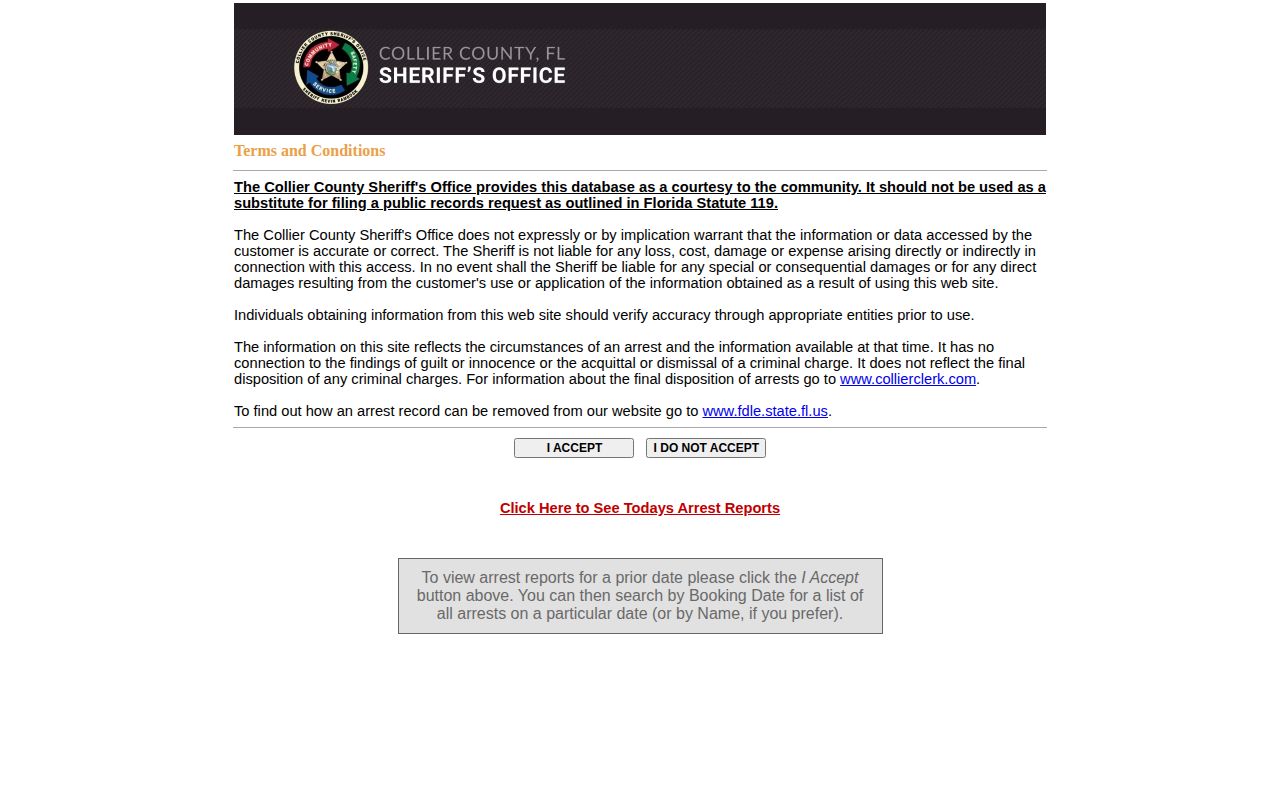
For a list covering a fixed period, request the existing releasable jail release log with exact Eastern Time start and end timestamps. Ask for the booking number, release timestamp, type or code, and destination fields. Item 22 of GS2 recognizes 24-hour commitment and release lists, but it does not prove CCSO publishes an online feed or must create a new analytical report.
Match Collier Releases to Court Outcomes
The Collier Clerk search supplies the judicial layer that CCSO's arrest history lacks. Its portal includes Dockets, Charges, Sentences, Fees, and Court Events. Search options can use sheriff, offender, incident, arrest, and booking identifiers, which makes it easier to tie a case to one custody episode. Read entries in order. A bond order may explain authority to leave, while a later judgment or dismissal answers a different question.
Use the Collier Clerk online case search to check disposition, sentence, jail credit, probation, amendments, and public sealing or expunction activity. A court order is not proof that jail processing ended at that same time. Conversely, a jail release record does not by itself state the final case result. When the two dates differ, preserve both and ask the custodians to explain the sequence.
The Clerk screen supports the division of work: the jail proves the physical event while the court file explains the judicial outcome.
Resources After a Collier Release
CCSO maintains a release-specific Reintegration page with English and Spanish guides, a veterans guide, and routes for health care, recovery, food and clothing, transportation, benefits, and other basic needs. The purpose-neutral contact is reentry@colliersheriff.org, with published numbers 239-252-9574, 239-252-9575, 239-252-9550, and 239-252-9530.
Reintegration help does not identify the legal release type or prove that supervision ended. Those questions still belong to CCSO, the Clerk, FDC, or FCOR. The local resource matters because a completed jail exit can create immediate practical needs even while a court case or supervision status remains active.
Registry Status After Collier Release
The FDLE offender registry uses a precise status, “Released - Subject to Registration.” For a person covered by the registration statutes, that means confinement and supervision have ended while the duty to register remains. The system also distinguishes FDC, DJJ, and federal supervision.
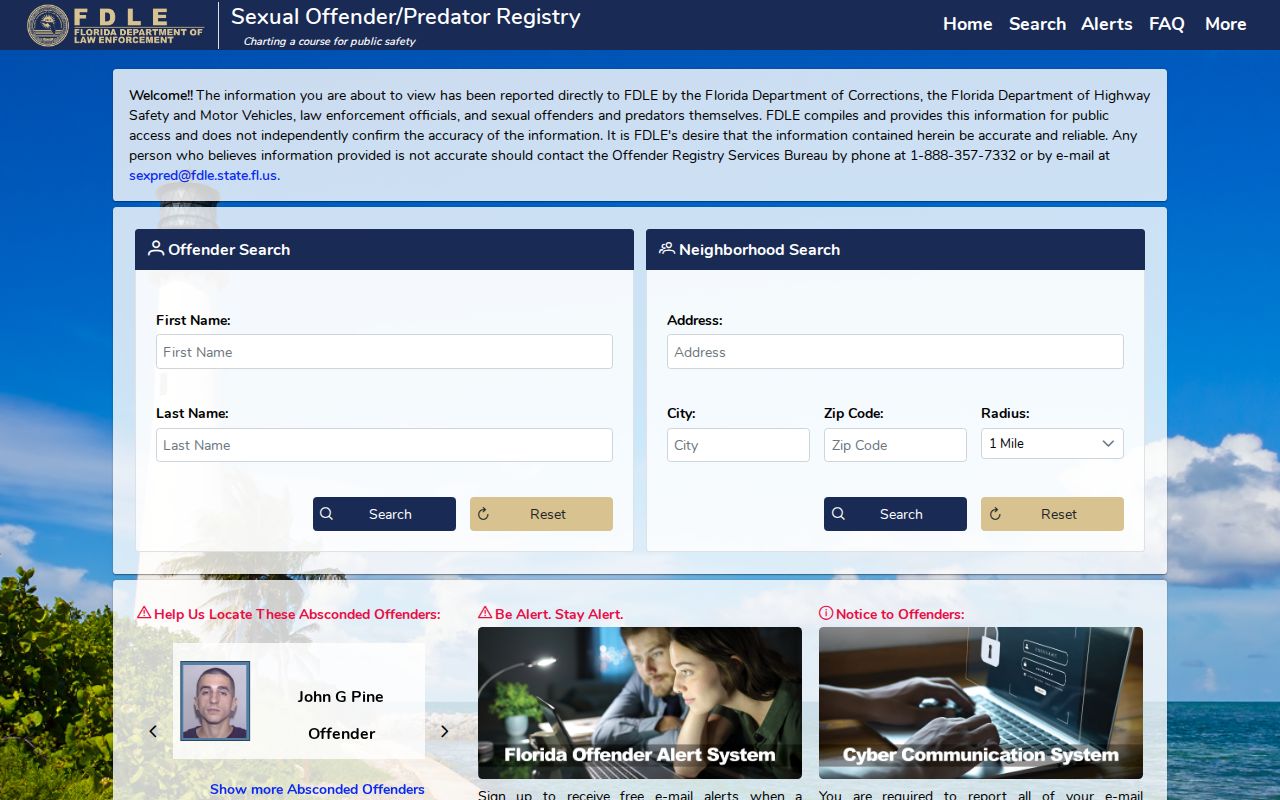
The registry interface is useful only for a person legally covered by that system and must not be treated as a countywide release list.
This is narrow evidence. It applies only to the statutory registry population and is not a general Collier County released inmate search. An ordinary released person is expected to have no entry. A registry match also needs the same identity checks used elsewhere, including photo, identifiers, and reported status, before it is linked to a Collier custody episode.
Collier Release Alerts and Federal Records
Florida VINELink relays custody events supplied by participating agencies. CCSO states that its VINE database covers a person whether incarcerated in or released from the Collier jail. Register while the correct record remains active, preserve the alert, and verify it with the jail. An archived record, offline-agency warning, or missing result is not proof of release. FDC supplies a separate state-prison record through the shared interface, and federal inmates are not covered.
The Florida VINELink interface provides the specific-person search and notification route.
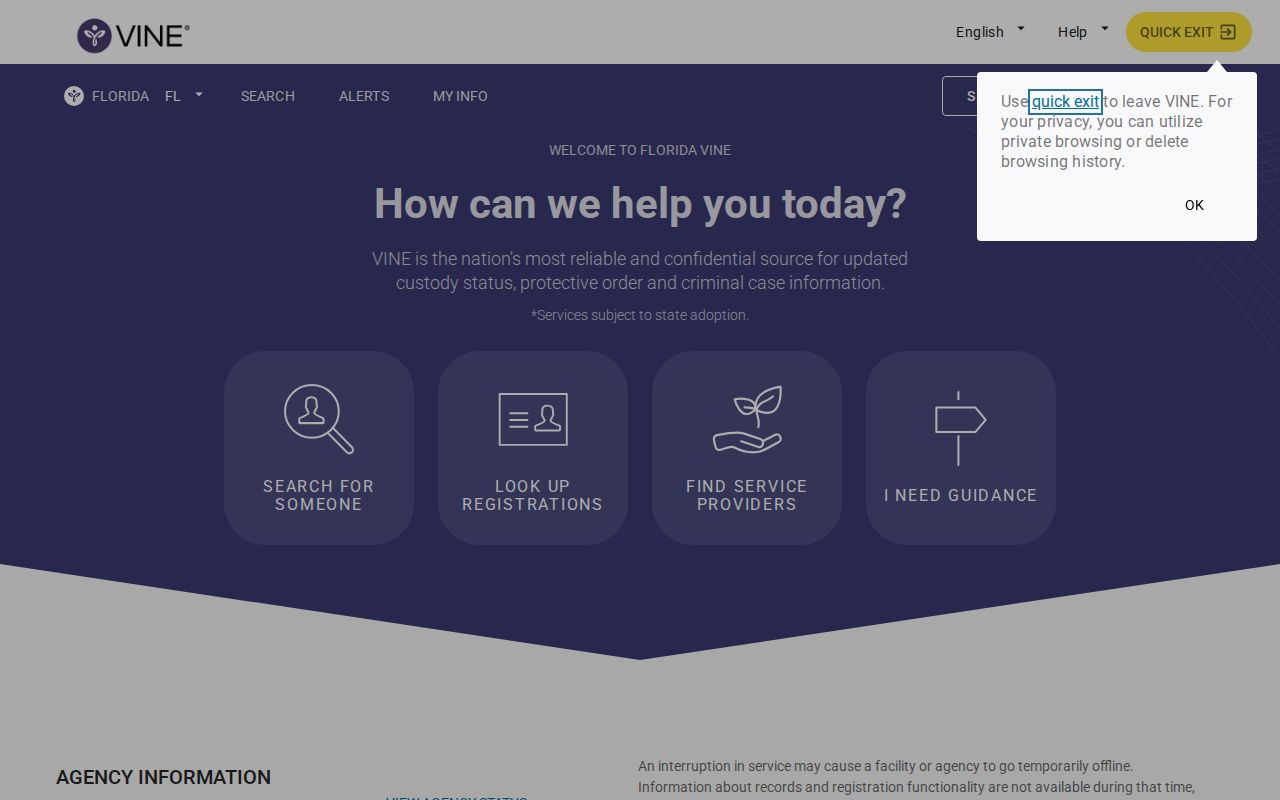
The display relays the source agency's event, so the reporting agency and facility must be checked before the alert is tied to a Collier release.
For a federal sentence, the BOP Inmate Locator covers federal records from 1982 to the present. A past Release Date and Location shown as RELEASED establish the end of BOP custody, not the end of supervised release or all other custody. USMS has no county-style public release feed. Federal court records and the responsible agency remain the better source for a specific order or transfer.
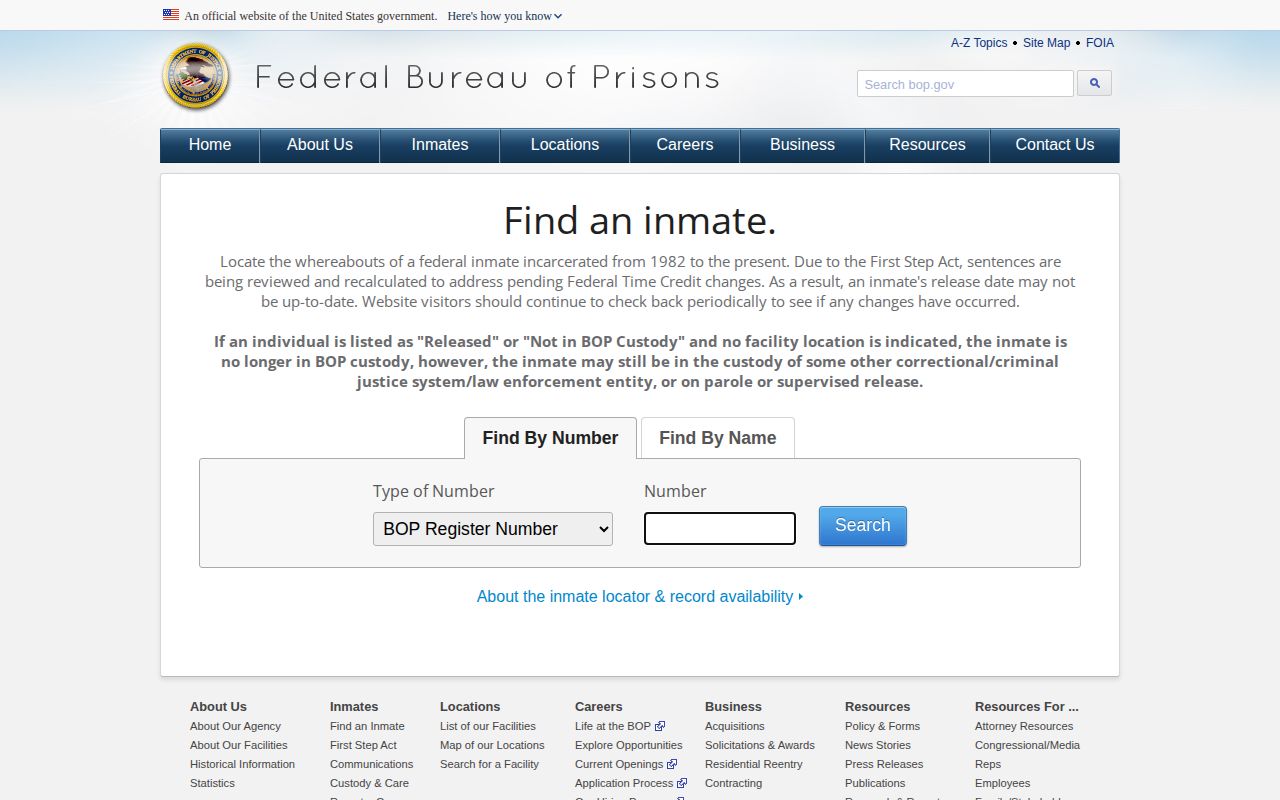
The locator view can confirm the end of a BOP custody episode, while another jurisdiction or supervision record may continue the timeline.
Collier Release to Krome Custody
Collier's 287(g) participation makes the destination check especially important. CCSO's local immigration guide says a person with an immigration matter generally remains in the county jail until state charges end or bond release occurs, then may be transported to Krome in Miami about two to four days later. That sequence ends county custody without proving return to the community.
First obtain the CCSO release type and destination. Then use the ICE Online Detainee Locator with the nine-digit A-number and country of birth, or exact biographical details. A-number searches are more reliable. ICE's “Not In Custody” result has several possible meanings and remains for a limited period, so it does not prove return to Collier. No result can reflect lag, spelling, a minor, a recent transfer, or limited coverage.
Download Mail After Collier Release
Collier's scanned-mail system gives the released account holder a distinct way to recover personal digital material. CCSO says a former inmate can use the inmate number and password at SmartInmate to download personal photos, messages, and scanned postal mail without charge after release. This is personal account access, not a public booking-photo search.
The rule should not be extended to physical booking property or someone else's messages. Those items may follow different jail procedures. The CCSO inmate communications page is the source for the digital download path. Trouble with a released account should be directed through the service or CCSO channel shown there, while errors in the official release record belong to Jail Records or Central Records.
Where Collier Release Records Appear
The same name can appear in several systems for different reasons. Choose the row that matches the last known custodian and the question being asked.
| System | Best use | What it cannot prove alone |
|---|---|---|
| CCSO live custody information | Whether the person remains in either county jail | Why an absent person left |
| CCSO release record | Actual county exit time, type, and destination | Final court disposition |
| Collier Clerk docket | Orders, disposition, sentence, and probation | Exact physical release time |
| FDC Offender Search | State prison release and state supervision | A county-only jail stay |
| VINELink | Source-supplied custody alerts | A certified release record |
| BOP or ICE locator | Federal or immigration custody path | Freedom from every other custodian |
Note: A completed release is best shown by matching the source agency's event to the next legal or custodial record.
Collier County Release Facilities
Naples and Immokalee are the two adult CCSO jail centers. The juvenile center is operated separately by DJJ and has confidential youth procedures. State, community-supervision, immigration, and federal pages describe continuation systems that serve Collier cases even when the institution is outside the county.
- Naples Jail Center: principal adult booking and release center.
- Immokalee Jail Center: adult booking and placement within the same CCSO system.
- Collier Juvenile Detention Center: confidential DJJ youth detention path.
- Florida Department of Corrections statewide institutions and community corrections: state prison release history.
- FDC Community Corrections Circuit 20 / Unit 201 Naples South: felony supervision after custody.
- Krome North Service Processing Center: documented immigration transfer destination.
- Federal Bureau of Prisons nationwide institutions: federal release-history route.
Each facility page follows the record held by that operator. A county jail release request should not be sent to FDC, and a federal release should not be inferred from the Collier arrest search.
Search Collier Release Records
Sponsored Results